Spring 2024 at The Met
The Metropolitan Museum of Art’s spring 2024 immersive exhibition offered visitors sensory experiences, including smells, soundscapes, and animations. Sleeping Beauties: Reawakening Fashion sought to “reawaken,” “reactivate,” and “reanimate” garments too delicate for regular display. The exhibit invites visitors to imagine how the garment was “worn or heard, touched, or smelled.”
Evocative Sensory Experiences
The exhibit used several sensory experiences to convey the object’s hidden past. Visitors could:
- See rarely displayed pieces of the collection.
- See immersive light projections and video animation.
- Hear soundscapes of distinctive garments, era music, and thematic sounds.
- Touch the texture of garments via wallpaper embossed with reproduced embroidery.
- Smell the “aromatic histories” of different garments and accessories.
- Appear to wear the garment using gesture-based animation and computer-generated imagery.
- Chat with the artificial intelligence of Jazz Age–era socialite Natalie Potter. (Presumably about her iconic 1930s French couture wedding gown.)
Soundscape of Status
The fine 18th-century gowns on display are representative of the wealthy and fashionable. Each gown bears elements that reflect the painstaking craftsmanship involved in its creation.
In this section, the soundscape of chiné silks adds depth to the experience. Playing overhead is the “scroop”—a term derived from “scrape” and “whoop”—of silk skirts. This noise captures the ephemeral movement of the wearer.

Pink silk taffeta woven with polychrome warp-dyed
floral vines, bowknots, and flowers.
Robe à la française, 1755–65
The blurred effect on this fabric is a weaving technique called chiné à la branche. This labor-intensive technique required the manipulating “branches” of warp threads during the weaving.

Ivory silk taffeta hand painted with wisteria, cherry blossoms, and asters.
Robe à l’anglaise, 1780
In the 1780s, artisans in China produced the silk for this robe à l’anglaise for European export. Once fabricated, skilled craftsmen hand-painted the silk with delicate, naturalistic flowers.
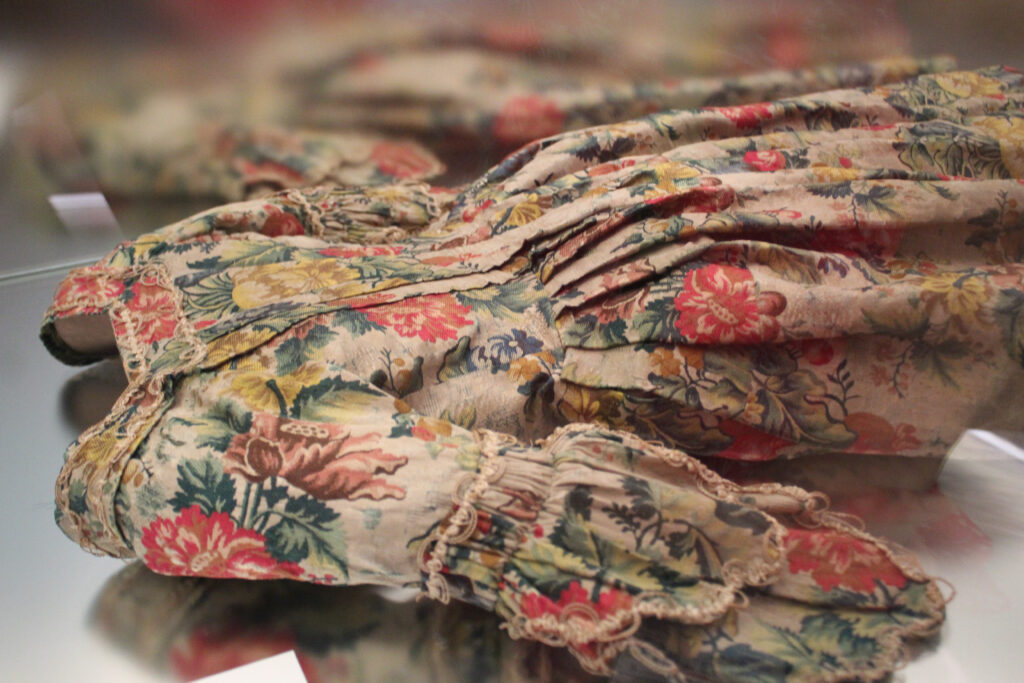
Light gray self-figured silk brocaded with polychrome silk thread in a pattern of pomegranates, poppies, and other flowers.
Robe à l’anglaise, 1765
This gown, ca. 1765, has been remade from a brocaded silk textile dated to 1730s-40s. This gown shows the evident skill needed to alter or remake clothes. Its careful construction highlights the labor involved.
Somnolent Smells of Sleeping Beauty
The smell displays varied from scented paint to whiffs delivered via plastic tubing. Exhibit text explains that the garments were “reawakened by reproducing their smell molecules.”
After extracting the smell molecules, chromatography identified the prominent notes. These notes were then replicated using synthetic odors.
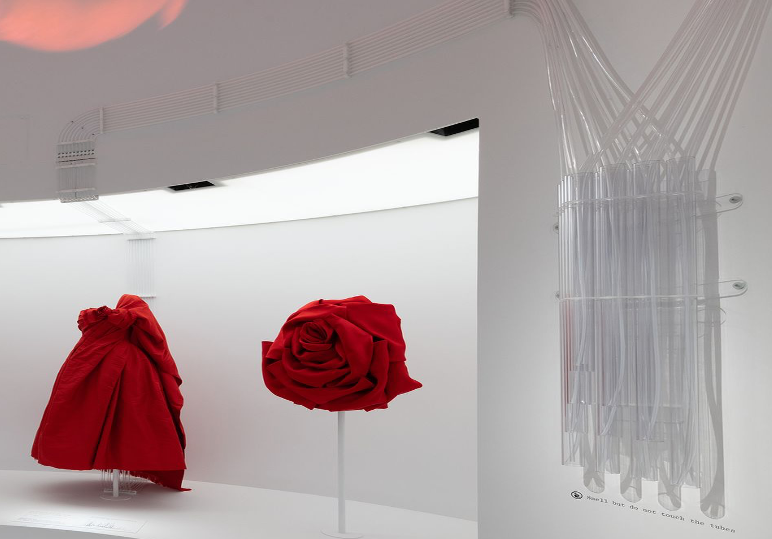
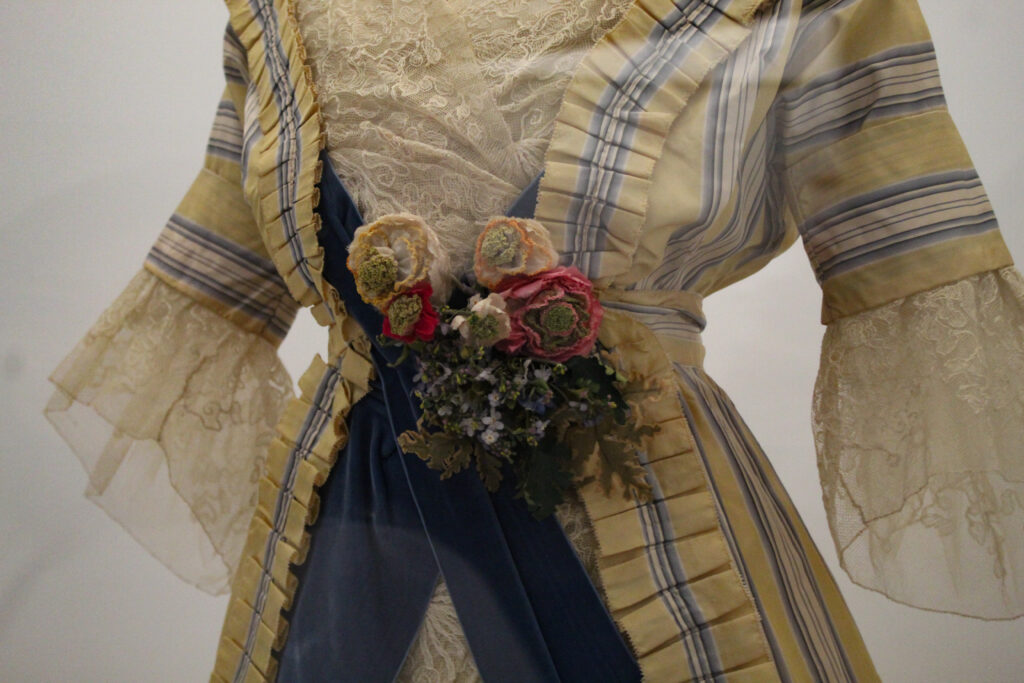
Yellow silk charmeuse overlaid with embroidered ivory silk net, striped yellow, blue, and white silk taffeta, trimmed with polychrome silk roses, poppies, and forget-me-nots.
House of Drecoll Dress, 1912
Inside the front neckline of this Marguerite de Wagner dress is a sachet in the shape of a sealed envelope. The sachet bears the name of the D’Orsay perfume, “Les Roses d’Orsay.”
“Roseraie” Lanvin Dress, 1923
This delicate Jeanne Lanvin ribbon-work evening dress holds hundreds of smell molecules. The most prominent are:
- isobornyl acetate: found in plants and herbs used in food and drinks in the 1920s.
- carvone: found in spearmint dental products.
- limonene: found in sprays used to cover up body odors on garments.
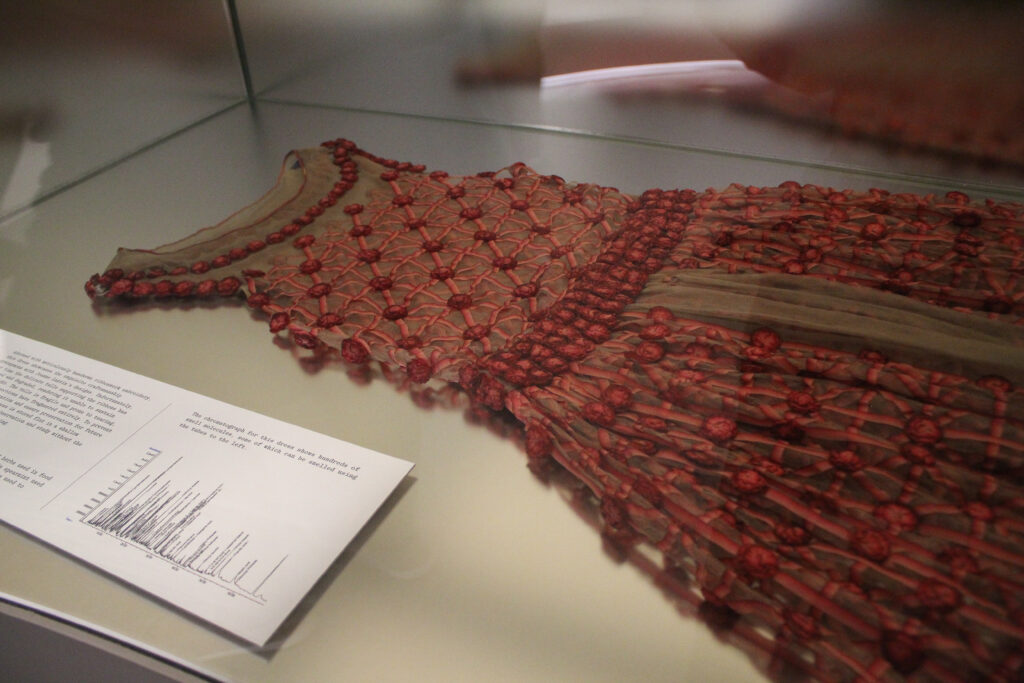
Beige silk tulle embroidered with red ombré silk
plainweave ribbon and red ombré silk plain weave
ribbon rosettes.
Sleeping Beauties Exhibition Details
New York. The Metropolitan Museum of Art. “Sleeping Beauties: Reawakening Fashion,” May 10–September 2, 2024.
Read the large-print exhibition text for Sleeping Beauties here.
Smell displays designed by Sissel Tolaas with support from Symrise
Technological activations by Nick Knight and SHOWstudio
Exhibition design by Leong Leong