Shakespeare’s The Merry Wives of Windsor may not be his most famous play, but this slapstick comedy has held a special charm for me—full of wit, mischief, and funny accents.
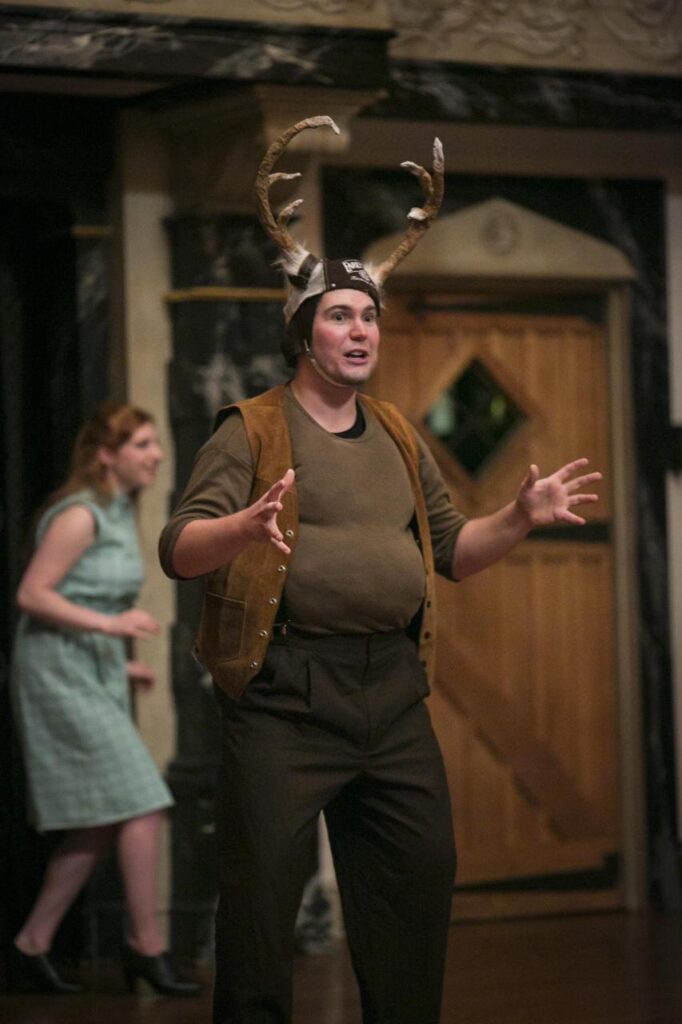
I had the opportunity to build Falstaff’s “horns”—actually antlers—for the American Shakespeare Center‘s Theater Camp‘s 2015 production of The Merry Wives of Windsor. Personally, this production felt quite nostalgic. I had previously portrayed the busy-body go-between, Mistress Quickly, in the same show with the ASCTC nine years before, as a camper.

About Falstaff’s “Pair of Horns”
William Shakespeare’s 1597 comedy The Merry Wives of Windsor features the bumbling knight Sir John Falstaff. Low on funds, he tries to seduce two wealthy wives. However, the women—Mistress Ford and Mistress Page—are quick-witted, wise to his scheme, and repulsed by his person. Amused by his futile flattery, they play a series of humiliating pranks on him.
In the final movement of the play, Falstaff wears a “pair of horns” to meet his would-be lover. At her request, he disguises himself as the mythic Herne the Hunter from Windsor Forest legend. Here, the horns represent power. They suggest a stag in rut: strong, desirable, and able to seduce. They also hint at an old figure of speech that a man whose wife is unfaithful “grows horns.”
Falstaff expects a romantic midnight meeting in the forest. Instead, townsfolk dressed as fairies scare and humiliate him. The horns now mark him as the one outwitted—and made the cuckold himself.
Building the Horns
Building the antlers involved blending Shakespearean symbolism with practical stagecraft. Although the antlers should look heavy and wild, they must be light and wearable onstage. The process combined sculptural creativity with practical problem-solving.
How to Build “A Pair of Horns”
- Modify a sturdy baseball cap by removing the brim.
- Use wire clothes hangers to construct a lightweight armature. Build up volume around the wire with aluminum foil.
- Apply layers of papier mâché over the foil to shape the horns.
- Once dry, paint the papier mâché with fawn and cream acrylics. Seal the painted horns with Mod Podge to add durability and a subtle shine.
- Reinforce the hat base with pleather fabric to support the antlers, then attach faux fur for texture.
- Finish by adding an elastic chin strap to ensure the headpiece stays securely in place.
The Merry Wives of Windsor
Dir. Kim Newton
Assistant Dir. Clara Everhart
American Shakespeare Center
ASC Theater Camp
Staunton, Virginia
July 2015