• Skip to primary navigation
  • Skip to main content
  • Skip to primary sidebar
Everhart Creative
  • Creative Work
    • Blog
    • Photography
    • Social Media
  • About
    • Testimonials
    • Disclosure & Privacy Policy
    • Cookie Policy
  • Let’s Connect

Immersive Art at Kensington Palace

January 15, 2026 by Clara Everhart Leave a Comment

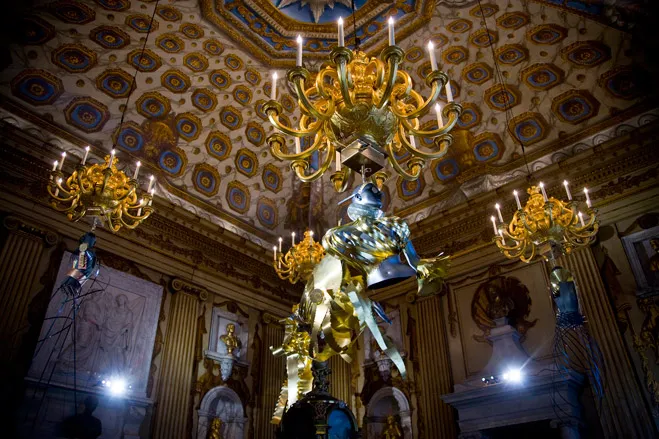
Boudicca's 'Dresses the colour of time' installation at Kensington palace, featuring a series of sculptural dresses, hanging from the chandeliers
(Image credit: Wildworks and HRP)
Dresses the Colour of Time by Boudicca in the Room of Palace Time. Photo courtesy of Wildworks.

Art and History Intertwined

Some exhibitions make an impression that doesn’t fade with time, lingering and resurfacing years later. For me, the Enchanted Palace at Kensington Palace was one of those experiences. 

I visited in spring 2010, and more than a decade later, several of its scenes remain vivid: glittering dresses suspended in half-light, whispered poetry, sorrow rendered tactile. Few historic sites have merged theatre, history, and imagination with such confidence.

The Enchanted Palace used light, sound, projection, and fantastical set dressing, alongside avant-garde fashion and storytelling by Wildworks, to conjure the lives of seven royal women spanning three centuries: Mary II, Anne, Caroline, Charlotte, Victoria, Margaret, and Diana. 

Their stories unfolded not as linear biographies, but as dreamlike reveries shaped by emotion: “love and hate, surprise and sadness, secrets and jealousy.” This was immersive history, filtered through dreamy, fairy tale logic. 
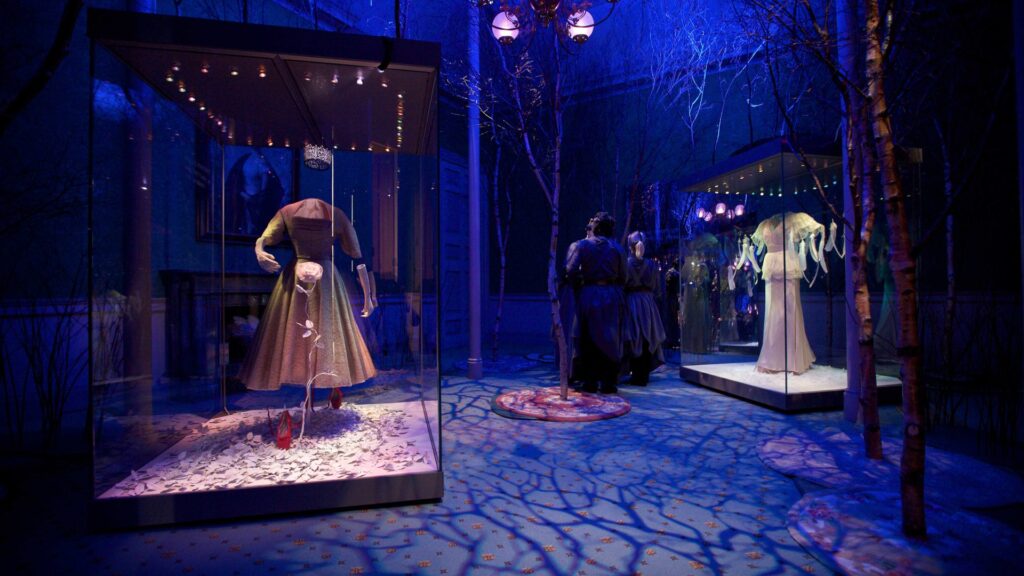
Extant gowns of late royals in an immersive history exhibition, blending theatre and fashion to reinterpret royal life in a historic palace setting. (Photo courtesy of Wildworks.)
Margaret and Diana’s extant gowns in The Room of Dancing Princesses. Photo courtesy of Wildworks.

Theatre and Time at Kensington Palace

Between 2010 and 2012, Kensington Palace became more than a historic residence. It became a stage, a canvas, and a site of imaginative play. In collaboration with Historic Royal Palaces, the theatre company Coney transformed the palace using immersive installations. These artworks placed fashion, art, and performance at the heart of royal history.

The Enchanted Palace (2010–2012) invited visitors to explore the lives of former residents—particularly princesses—through participatory, multisensory encounters. Costumes, objects, poetry, soundscapes, and interactive design turned visitors into active witnesses rather than passive viewers. 

Later installations, including House of Cards, continued this approach, further blurring the line between exhibition and performance, positioning visitors as witnesses to the palace’s layered past.
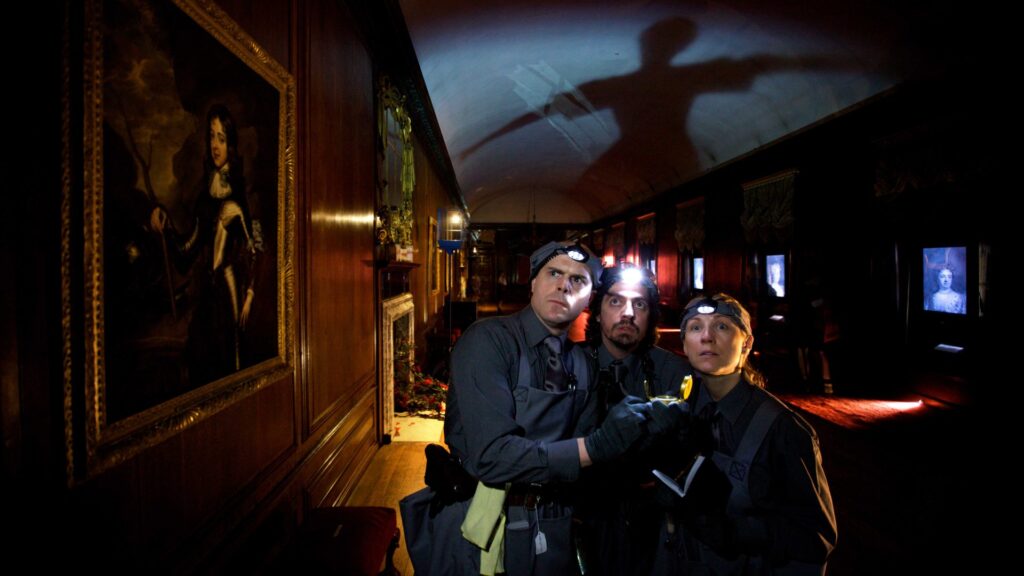
Wildworks performers in The Gallery of Dancing Shadows. Photo courtesy of Wildworks.

Transforming the Stories of Seven Princesses

Wildworks artists, led by Bill Mitchell alongside light artist Chris Levine, began by taking a “sensory inventory” of the palace’s rooms. These spaces became emotional portals, each tied to a royal woman. 

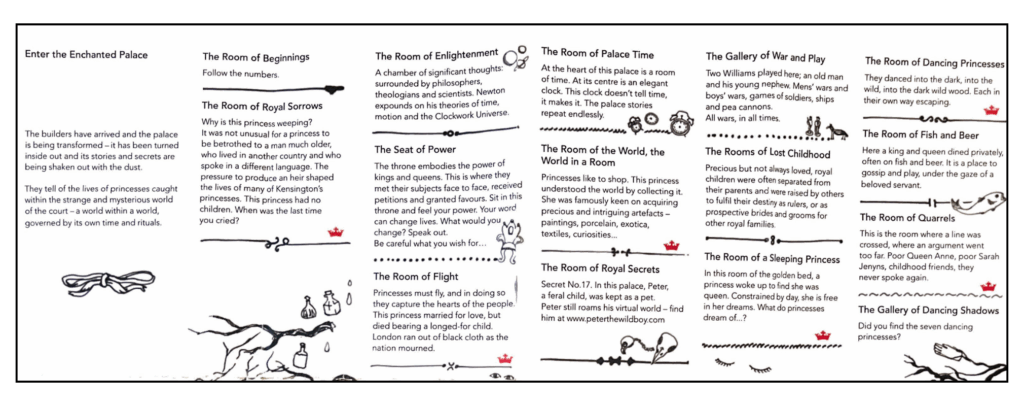
Armed with a hand-drawn map, visitors explored the transformed space to uncover the “true fairy tales” inspired by each princess. In seven of the rooms (denoted with a red crown on the handout), the name of a princess could be found. It wasn’t until the exhibit’s final room, the Gallery of Dancing Shadows (the Queen’s Gallery), that lightbox portraits identified each woman, playing her favorite music and sending a dancing shadow across the length of the gallery.
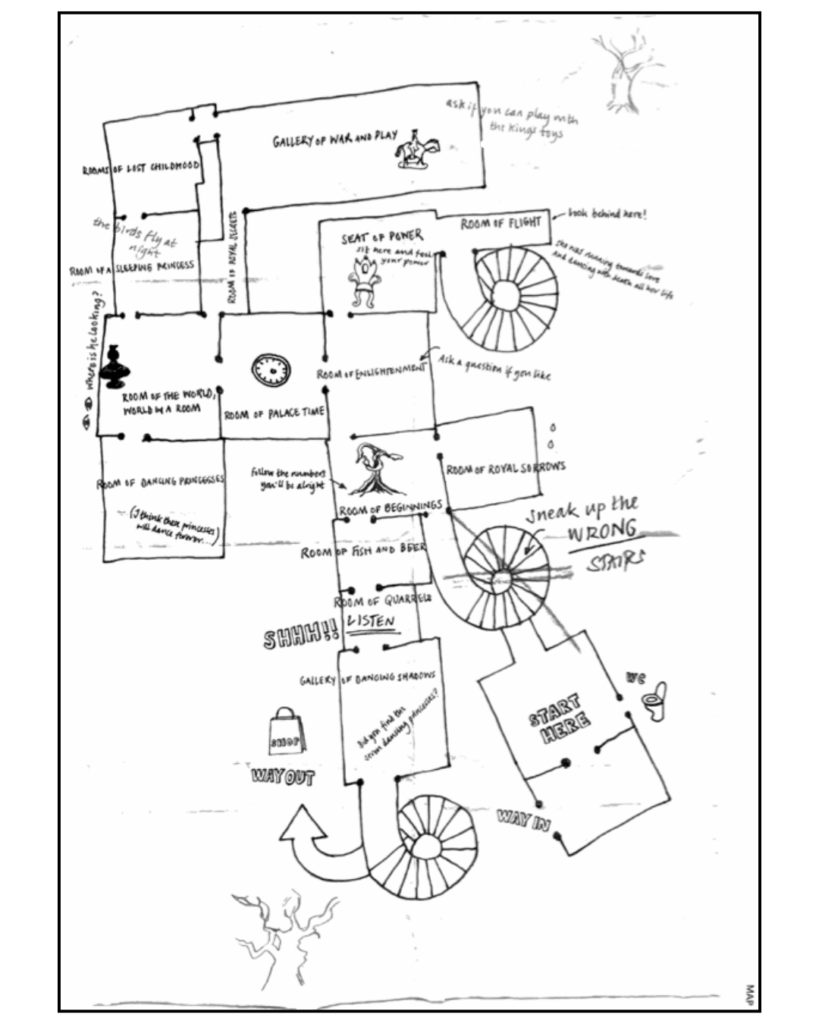
Room of Beginnings (The Queen’s Drawing Room)
Room of Royal Sorrows (The Queen’s Bedroom)
Room of Enlightenment (The Privy Chamber)
Seat of Power (The Presence Chamber)
Room of Flight (The King’s Staircase)
Room of Palace Time (The Cupola Room)
Room of the World, World in a Room (The King’s Drawing Room)
Room of Dancing Princesses (The King’s Privy Chamber)
Gallery of War and Play (King’s Gallery)
Room of a Sleeping Princess (Queen Victoria’s Bedroom)
Room of Royal Secrets (Anteroom in Queen Victoria’s Bedroom)
Room of Lost Childhood (Duchess of Kent’s Dressing Room)
Room of Fish and Beer (The Queen’s Dining Room)
Room of Quarrels (The Queen’s Closet)
Gallery of Dancing Shadows (The Queen’s Gallery)

Map of the Enchanted Palace

  • Room of Beginnings
  • Room of Royal Sorrows
  • Room of Enlightenment
  • Seat of Power
  • Room of Flight
  • Room of Palace Time
  • Room of the World, World in a Room
  • Room of Royal Secrets
  • The Gallery of War and Play
  • Rooms of Lost Childhood
  • Room of a Sleeping Princess
  • Room of Dancing Princesses
  • Room of Fish and Beer
  • Room of Quarrels
  • Gallery of Dancing Shadows
Enter the Enchanted Palace
The builders have arrived and the palace is being transformed —it has been turned inside out and its stories and secrets are being shaken out with the dust. They tell of the lives of princesses caught within the strange and mysterious world of the court—a world within a world, governed by its own time and rituals.
The Room of Beginnings
Follow the numbers.
The Room of Royal Sorrows
Why is this princess weeping? It was not unusual for a princess to be betrothed to a man much older, who lived in another country and who spoke in a different language. The pressure to produce an heir shaped the lives of many of Kensingtons princesses. This princess had no children. When was the last time you cried?
The Room of Enlightenment
A chamber of significant thoughts surrounded by philosophers, theologians and scientists. Newton expounds on his theories of time, motion and the Clockwork Universe.
The Seat of Power
The throne embodies the power of kings and queens. This is where they met their subjects face to face, received petitions and granted favours. Sit in this throne and feel your power. Your word can change lives. What would you change? Speak out. Be careful what you wish for.
The Room of Flight
Princesses must fly, and in doing so they capture the hearts of the people. This princess married for love, but died bearing a longed-for child. London ran out of black cloth as the nation mourned.
The Room of Palace Time
At the heart of this palace is a room of time. At its centre is an elegant clock. This clock doesn't tell time. It makes it. The palace stories repeat endlessly.
The Room of the World, the World in a Room
Princesses like to shop. This princess understood the world by collecting it. She was famously keen on acquiring precious and intriguing artefacts — paintings, porcelain, exotica, textiles, curiosities...
The Room Of Royal Secrets
Secret No. 17. In this palace, Peter, a feral child, was kept as a pet. Peter still roams his virtual world — find him at www.peterthewildboy.com
The Gallery of War and Play
Two Williams played here; an old man and his young nephew. Mens' wars and boys' wars, games of soldiers, ships and pea cannons. All wars, in all times.
The Rooms of Lost Childhood
Precious but not always loved, royal children were often separated from their parents and were raised by others to fulfil their destiny as rulers, or as prospective brides and grooms for other royal families.
The Room of a Sleeping Princess
In this room of the golden bed. A princess woke up to find she was queen. Constrained by day, she is free in her dreams. What do princesses dream of...?
The Room of Dancing Princesses
They danced into the dark, into the wild, into the dark wild wood. Each in their Own way escaping.
The Room of Fish and Beer
Here a king and queen dined privately, often on fish and beer. It is a place to gossip and play, under the gaze of a beloved servant.
The Room of Quarrels
This is the room where a line was crossed, where an argument went too far. Poor Queen Anne, poor Sarah Jenyns, childhood friends, they never spoke again.
The Gallery of Dancing Shadows
Did you find the seven dancing princesses?

Accompanying Poetry

Accompanying each princess was a spoken-word poem by Wildwork’s Mercedes Kemp, inspired by each princess’s life. These poems, displayed and played on a loop in each exhibit room, served as inspiration for the exhibit and the dress designers. (As an American tourist, I had a hard time parsing the performers’ dialects in the recordings.)

The poems are written in a contemporary narrative free-verse style, marked by frequent line breaks and enjambment that produce a fragmented, almost staccato rhythm. Drawing on the familiar language of fairy tales, each poem reframes a woman’s experience as a densely symbolic fable. Rich in imagery and sensory detail, the poems at times allow atmosphere and symbol to eclipse a single, unified meaning, favoring emotional resonance over narrative clarity.
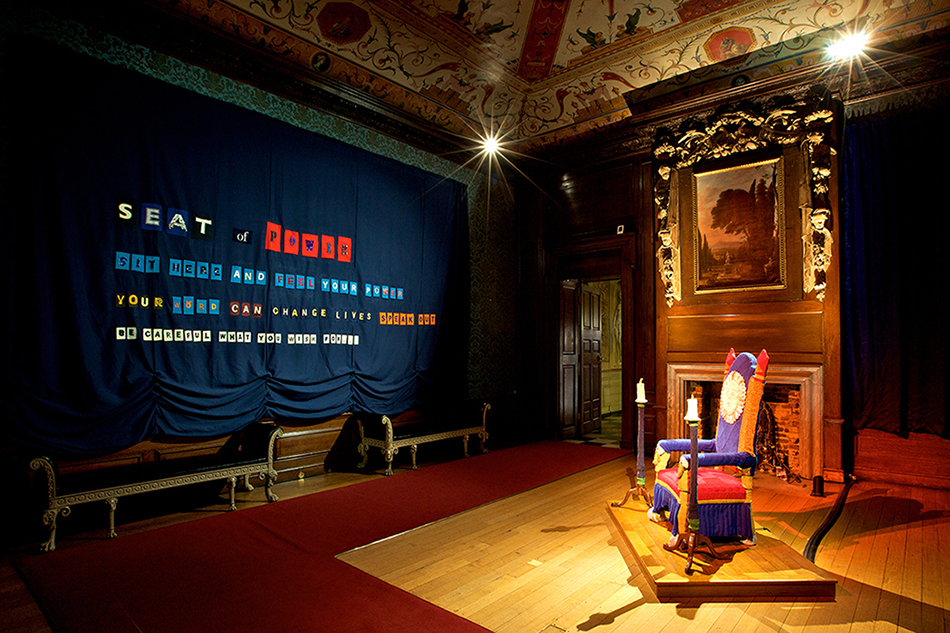
Immersive museum exhibition exploring power and authority inside a historic royal interior, using theatrical staging and artistic interpretation. (Photo courtesy of Wildworks.)
The Seat of Power in Kensington Palace’s Presence Chamber. Photo courtesy of Wildworks.

A Beautiful Reduction?

At times, I found this poetry to be more obfuscating than illuminating. Kemp’s poetry went “beyond the specific detail of these past lives, and drew on the universal.” While universalizing each woman’s emotions encouraged empathy in the visitor, it also reduced each woman’s legacy to emotional shorthand. Weeping Mary. Bitter Anne. Curious Caroline. Doomed Charlotte. Stifled Victoria. Dancing Margaret. Disillusioned Diana. Complexity gave way to archetype.

I more fully explore the reduction of Mary in The Room of Royal Sorrows.

You can read about audience pushback in the Room of Flight on The King’s Staircase.

The co-mingling of princesses was, at times, genuinely moving. Their lives blurred into one another, highlighting the structural constraints they faced as royals rather than focusing solely on their individual historiographies. Yet this same approach raises an uncomfortable question of reductionism. There is more to any woman’s life than can be captured in a single word, image, or symbol.

While I admire the artistry and transformation of space achieved by Wildworks, I wonder whether any “true life fairy tale” could ever convey the complexity of real people—or whether such an approach inevitably collapses into fairy-tale archetypes. Can immersive art in historic spaces deepen understanding without simplifying its subjects? Or does enchantment, by its nature, demand a kind of reduction?
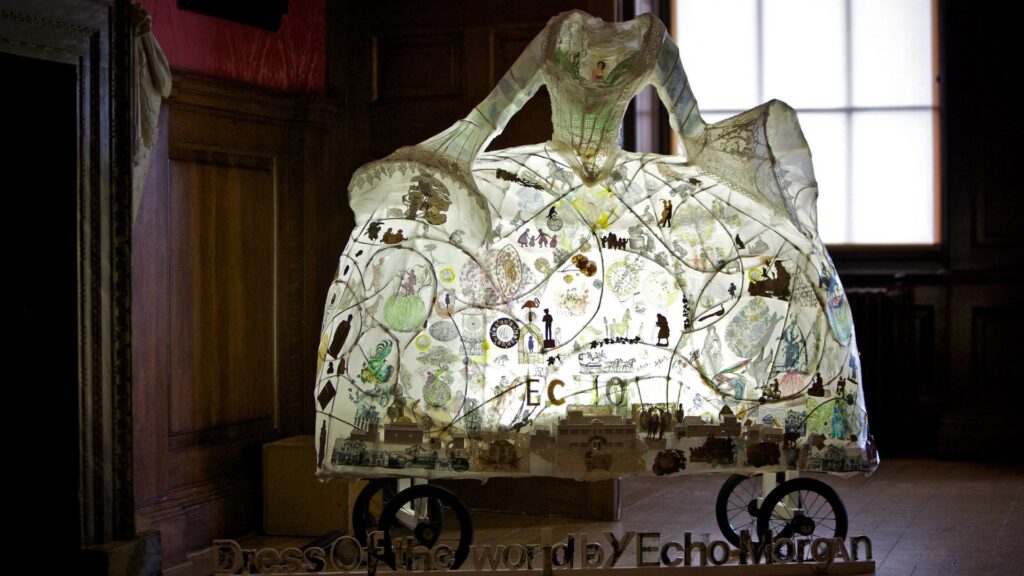
'Dress of the World' by illustrator and set designer Echo Morgan. (Image credit: Wildworks)
The Dress of the World in the Room of the World, World in a Room. Photo courtesy of Wildworks.

Did You See The Enchanted Palace?

The Enchanted Palace remains unforgettable. Its legacy lies not only in what it achieved, but also in the questions it leaves behind about imagination, interpretation, and the limits of storytelling in historic places.

If you visited the Enchanted Palace, I’d love to hear your thoughts. Or perhaps you’ve experienced other immersive installations. Suggest the place I should visit next!

Filed Under: Inspiration, Museums Tagged With: Historic Royal Palaces

Previous Post: « Christmastime and the Making of Gentility in Colonial Maryland
Next Post: The Enchanted Palace’s Room of Royal Sorrows »

Reader Interactions

Leave a Reply Cancel reply

Your email address will not be published. Required fields are marked *

Primary Sidebar

Let’s Connect

  • Email
  • Facebook
  • Instagram
  • Pinterest

About the Artist

Clara Everhart is an emerging photographer, capturing the work of individual historians, reenactment units, and historic sites during the US 250th and beyond.

Subscribe to the Newsletter

I'll never send you spam.

Check your inbox to confirm your subscription.

Copyright © 2026 Everhart Creative on the Foodie Pro Theme