In May 2010, I visited the Enchanted Palace, a temporary immersive exhibition at Kensington Palace which reinterpreted royal history through sound, light, fashion, and poetry. Part of what fascinated me was the audience’s reaction to the Enchanted Palace‘s unique approach. I previously wrote about that trip here, including my take on the Room of Royal Sorrows. This post focuses on one encounter at the King’s Staircase, centered on a dramatic installation known as the Dress for Rebellion.
An Artistic Gamble at Kensington Palace
In the spring of 2010, London’s Kensington Palace underwent a 20-month-long, £12 million restoration. In lieu of a complete closure, Historic Royal Palaces (HRP) collaborated with site-specific theatre company Wildworks to present a creative exhibition.
The resulting mix of sound, light, and contemporary art marked a significant departure from Kensington Palace’s usual interpretive style. The exhibition was an artistic gamble. While many visitors embraced it, a vocal minority responded with disappointment and anger.
Wildworks’ Detectors and Participatory Play
Wildworks’ theatre practice is deliberately collaborative, inviting audiences into shared acts of storytelling. A premium is placed on instilling curiosity in the visitor.
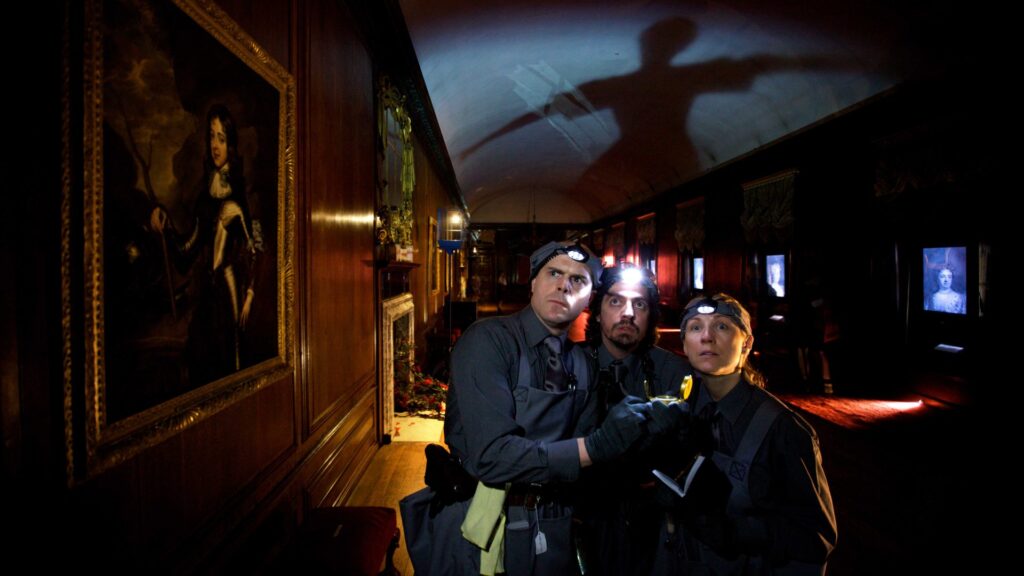
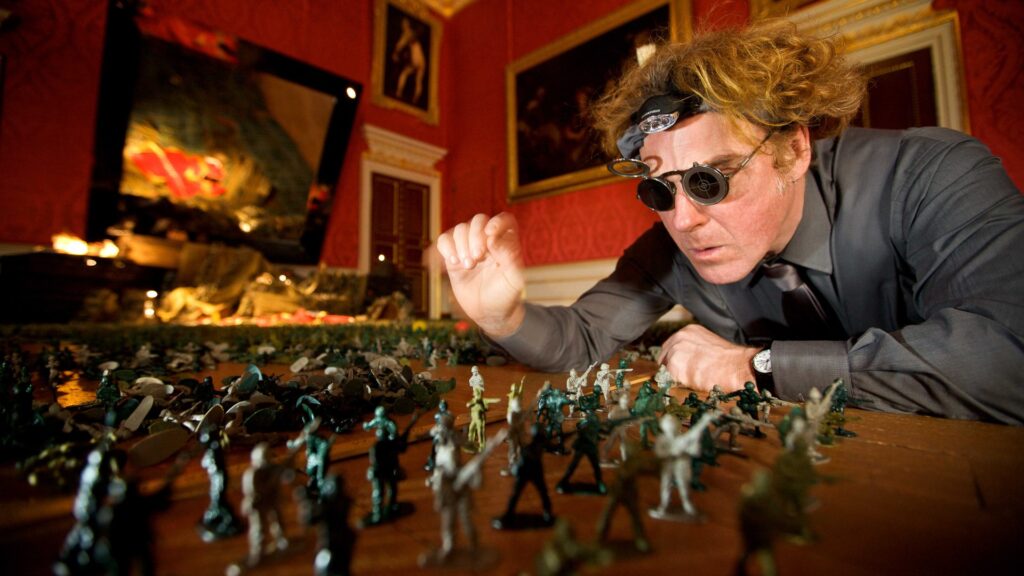
Throughout the exhibition, visitors encountered costumed “Detectors”: goggle‑wearing, steampunk‑styled figures who encouraged observation, reflection, and engagement with both the installations and the historic site.
Whenever I encountered the Detectors, they were surrounded by groups of children who hung onto their every word. Without voice amplification, I struggled to follow their dialogue and eventually moved on. Although I crossed paths with them several times, my more substantive interactions were with the palace’s Explainers.
Explainers and the Limits of Guidance
Peppered throughout the exhibition spaces, Explainers (Kensington Palace front-of-house staff) were available to answer questions. In keeping with the exhibition’s emphasis on curiosity, however, they did not volunteer information. Visitors were expected to initiate engagement.
Often positioned near large printed spreads of poetry by Wildworks artist Mercedes Kemp, the Explainers occupied an ambiguous role. I found myself unsure how to approach them. The rules of participation—what could be asked, how much explanation might be offered—were unclear.
The King’s Staircase and the Dress for Rebellion
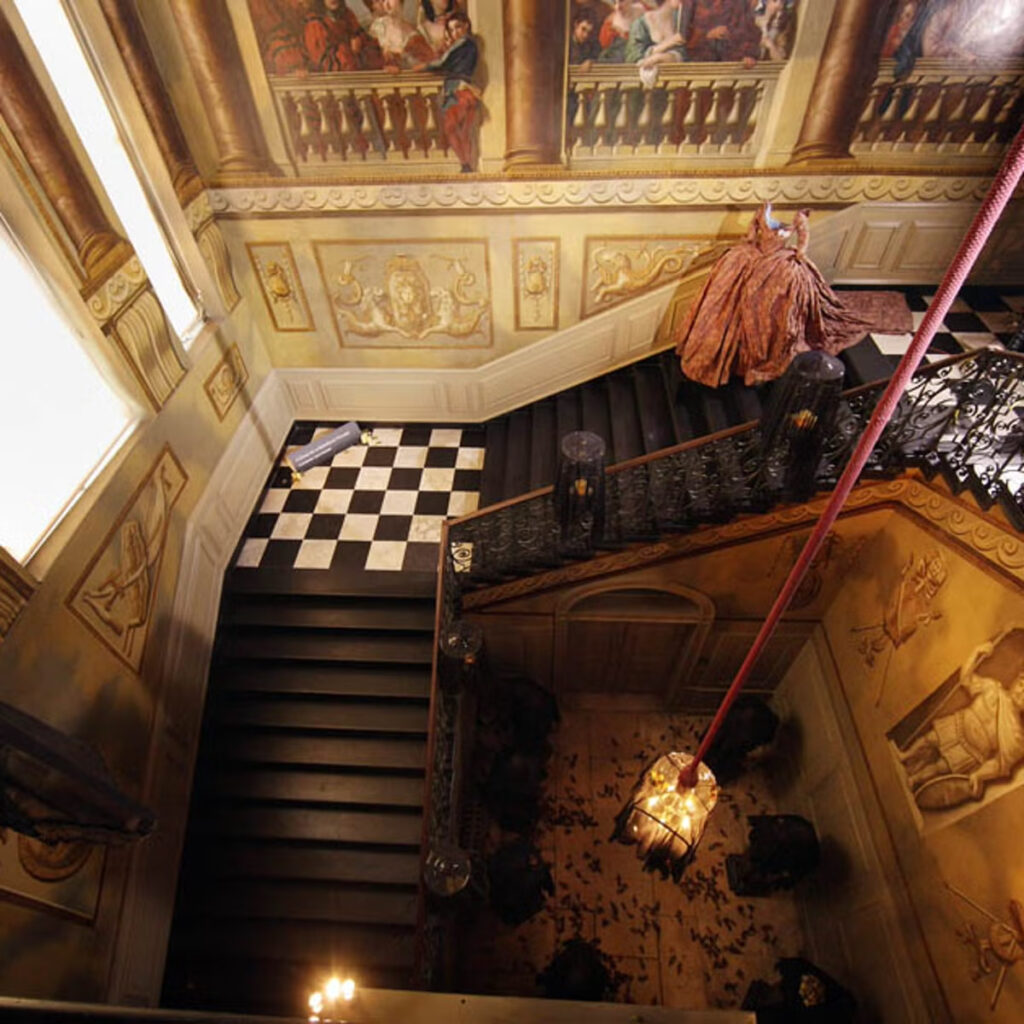
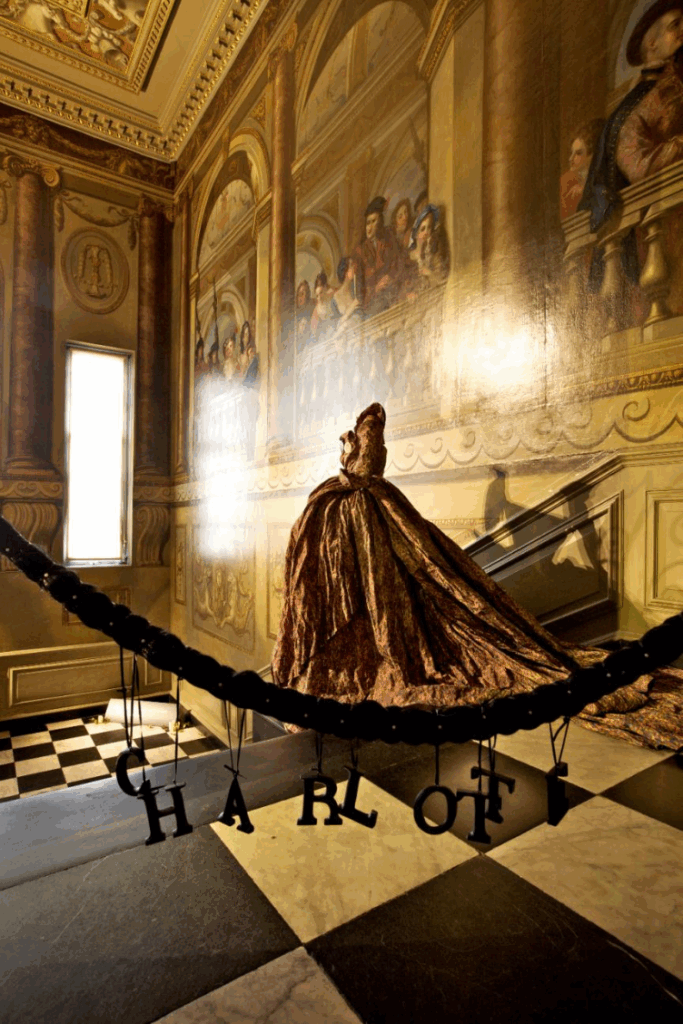
The King’s Staircase, Kensington’s maximalist trompe-l’œil of the court of George I, was transformed into what the exhibition called the Room of Flight. Visitors approached the top of the roped-off stairs to look down on the gowned figure. The floor below, covered in black swags and dark leaves, hinted at an encroaching forest.
Caught mid-flight—almost Cinderella-like—the Dress of Rebellion appears to be descending the staircase as if fleeing the proverbial ball as the clock strikes midnight.
The Dress for Rebellion was a romantic, sumptuous eighteenth–century–inspired gown that held its own amid the stairs’ vibrant surroundings.
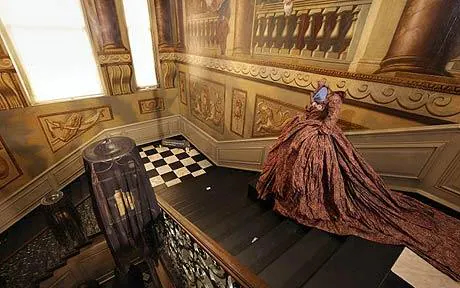
Fashion designer Vivienne Westwood and artist Mydd Wannell combined two silhouette types: Georgian and Hollywood Regency.
The result was a dress equally suited to an independent princess born at the end of the Georgian era or a Golden Age Hollywood leading lady.
A Moment of Audience Pushback
As I stood at the top of this famous staircase, I witnessed a German tourist unloading her ire onto a member of the palace’s front-of-house staff.
“What is the purpose?” the woman demanded. “You cannot simply tell me what I am seeing?” She appeared to be in her mid-sixties, her irritation sharp and unmistakable.
The staff member, an older woman whose name tag read “Ida,” was apologetic. She attempted to explain the exhibition’s premise and ended with: “I can answer questions.”
“I came to see the palace,” the visitor continued. “Not this.”
Armed only with aggressive American friendliness, I stepped in, smiling, to rescue Ida by asking any question that came to mind. I suspect she bent the rules by entertaining such broad inquiries as: Who is portrayed here? Why place her on the staircase?
Princess Charlotte
In answering, Ida spoke about Princess Charlotte, the much-beloved granddaughter of King George III, during the Regency period of early nineteenth-century Britain. As the king’s only legitimate grandchild, Charlotte stood second in line to the throne.
Known for her rebellious, headstrong nature, Charlotte defied her father’s plans for a political marriage; she wed a Belgian prince for love. Tragically, at just twenty-one years old (after only a year and a half of marriage), Charlotte died in 1817 following the delivery of a stillborn son.
Transition and Tragedy
Ida explained that Charlotte’s position on the staircase suggested transition—leaving one world and entering another.
As Ida spoke, the spoken-word poetry of Wildworks artist Mercedes Kemp reverberated through the space, cutting across the ambient noise of the crowd:
She was running towards love
and dancing with death all her life.
Before Ida had finished her account, the frustrated visitor had moved on. I thanked my Explainer and asked whether hostile encounters like that were common.
“This exhibition,” she said, shaking her head. “It really bothers some people.”
Extreme Reactions: Praise and Protest
In the 2012 article Does the Queen know about this? Audience development and reaction to the Enchantment of Kensington Palace: L. K. Humphreys shows that the Enchanted Palace attracted a higher volume of traffic than usual. Visitor numbers were up 22% on the previous year’s peak.
Praise
In addition to Kensington Palace’s core audience of international visitors and those drawn by its connection to Princess Diana, the exhibit attracted two new audiences: families with kids and urban Londoners.
Those visitors left comments in an unprecedented outpouring of opinion. The feedback shared in the palace’s guest comment book was overwhelmingly positive: 75% positive, 20% neutral, and 5% negative.
“Just the most magical experience in Heritage – Aug 2010 – The Palace is under major refurbishment, but the Enchanted Palace exhibition is fantastic. It’s emotive, it’s innovative, and completely original. Historic Royal Palaces could have shut this beautiful building down for years, but they saw an opportunity to do something massive, and that’s what they have done.
It’s not your average historic house offering, and if you’re interested in stuffy, unoriginal interpretation, then you will hate it. If you want to try out something different and look at History in a much less classroom way than you will elsewhere, then this is the place for you. It is a truly, truly outstanding example of originality within a museum, and I cannot wait to return!”
TheBogart on TripAdvisor, written January 11, 2011
“Was I at the same exhibition as the reviewers below?? I visited the Enchanted Palace exhibition yesterday, with three other adults and three children aged 9-14. We were all captivated by an imaginative and magical experience. The usual palace is (to my mind) a bit dull. This clever use of old and modern transformed it for the better. I saw no one clamouring for a refund and would gladly go again.”
Jerry1953 on TripAdvisor, written April 14, 2010
Protest
However, the immersive experience also provoked some extreme negative reactions from visitors. A highly vocal minority expressed their concerns in the palace’s visitor book, on online forums like TripAdvisor, and even in complaint letters to the Queen, according to Humphreys.
Visitors also brought their complaints directly to staff. Some of those unhappy visitors were shouting and aggressive, upsetting the front-of-house staff. I happened to witness one such encounter.
“This is not what I expect of a historical palace. We were expecting royal collections, antique furniture, interactive equipment, lots of easily accessible information, and a feeling that we were in a historical palace. We got none of that. It is now called the enchanted palace, and we left feeling far from enchanted, more “ripped off” and totally uninformed of anything historical.”
FarnhamTourist987 on TripAdvisor, July 10, 2010
“Stay away! After spending 25 pounds for two tickets, we wandered through a series of nearly pitch-black rooms festooned (desecrated would be a better word) with bizarre, kitschy, modern-day “art” installations seemingly aimed at young girls. Yes, some original furnishings remain, but the rooms are so dark that you can’t see the wallpaper, carpets, and furniture, and there is no information posted as to who used the rooms and for what purpose. The hallways are covered with cartoonish graffiti. It seems that a group of delusional “artists” were unleashed in this historical palace, to disastrous effect. And apparently it’s been bombarded with complaints, because a staffer stands outside to warn you, before you buy tickets, that it’s “under transformation.” However, she deftly skirted the reservations we raised, insisting that the new decor was for “all ages” and that “no original furnishings have been removed from the rooms”— neglecting to mention that they’re shrouded in darkness. Save your money—this is a ripoff, and a shame.”
Mittens67 on TripAdvisor August 31, 2010
A Disrupted Contract
The backlash against Enchanted Palace reveals more about visitor expectations than it does about the exhibition itself. For some, Kensington Palace (and the other sites intertwined with royal history) represents stability and authoritative interpretation. Enchanted Palace disrupted that contract, asking visitors to infer meaning rather than receive it.
As the comments quoted above suggest, for many, this was exhilarating; for others, it felt like a refusal to explain.
Emotional Labor of Staff Members
Regrettably, the tension inherent in disrupting the usual visitor experience fell not on the exhibit’s designers, but on front-of-house staff like Ida. Their role was to hold space for frustration while maintaining a deliberately ambiguous interpretive framework. This emotional labor became a foundational, but unacknowledged, part of the exhibit’s design.
Still, the palace team rose to the occasion. L. K. Humphreys’ 2012 article on audience reception of the Enchanted Palace notes that, among the 148 Tripadvisor reviews, the front-of-house team was the most common target of praise, even in negative reviews.
When the Visitor Shares the Task of Interpretation
The reception of Enchanted Palace demonstrates that immersive, interpretive exhibitions do not simply reshape visitor experience; they redistribute responsibility.
Meaning-making became a shared, and sometimes uncomfortable, task—one that visitors did not universally consent to undertake. Some visitors are willing to suspend disbelief and engage in theater-making. Some visitors are not.
While designers authored the ambiguity, it was the front-of-house staff who absorbed its consequences in real time.