In March of 2019, I found myself stepping into Confection at the Folger Shakespeare Library reading rooms. Folger Theater commissioned the multi-sensory dance and theater performance. The immersive theatre company Third Rail Projects, based in NYC, created it. (I am a big fan of immersive art projects; read about my experience at Masquerade NYC and the Enchanted Palace at Kensington.)
I came to the evening already primed with excitement. I’ve spent a good deal of time in spaces shaped by Shakespeare, most notably the American Shakespeare Center’s Blackfriars Playhouse. As a result, I developed a deep interest in the plays themselves and the era that produced them. The more I learn about the Early Modern period, the more I see the similarities between that period and now.
One of the themes of the Early Modern period that reverberates to the present day is the subject of Confection. The ravenous European appetite for sweetness and the slave trade are forever intertwined. This connection was driven by the expansion of sugar plantations. Its production also required forced, dangerous labor.
As demand from European markets increased, capitalist entrepreneurs scaled production to meet it. In turn, the system of slavery expanded and intensified. By the 18th century, these inhumane conditions had only grown more entrenched.
Sweetness, Sourced: Inspired by Historical Research
The show was commissioned to accompany the project Before ‘Farm to Table’: Early Modern Foodways and Cultures, a collaborative humanities research initiative from the Folger Shakespeare Library and the Andrew W. Mellon Foundation.
During the run of the production, the Folger displayed a related exhibit also originating from the Before ‘Farm to Table’ body of research. First Chefs: Fame and Foodways from Britain to the Americas explored the lives of both celebrated and overlooked figures in early modern food culture. The stories of these chefs set the excesses of a wealthy elite against the human cost that literally sustained them.
(I was happy to see my favorite historic celebrity chef, Hercules Posey, in the exhibit. He rose to fame as George and Martha Washington’s enslaved chef, and successfully self-emancipated in 1797.)
Staging Excess: Immersive Theater with Third Rail Projects
Zach Morris of Third Rail Projects characterized the immersive show in an SAT analogy: “Our work is to a traditional play like a Pablo Neruda poem is to a novel.” The non-linear kaleidoscope of live dance/theater performances, dramatic recitations, and thematic scenes “accumulates meaning” for the audience.
To create the Confection kaleidoscope, Morris and his creative team drew on Folger Theatre’s concurrent production of Nell Gwynn. Inspired by the real story of the 17th-century English actress who rose from obscurity to a society figure and mistress of Charles II.
Nell’s remarkable rise from orange-seller to an actress on stage, to enjoying the decadent banqueting and feasting of the Restoration court, flavored the performances in Confection.
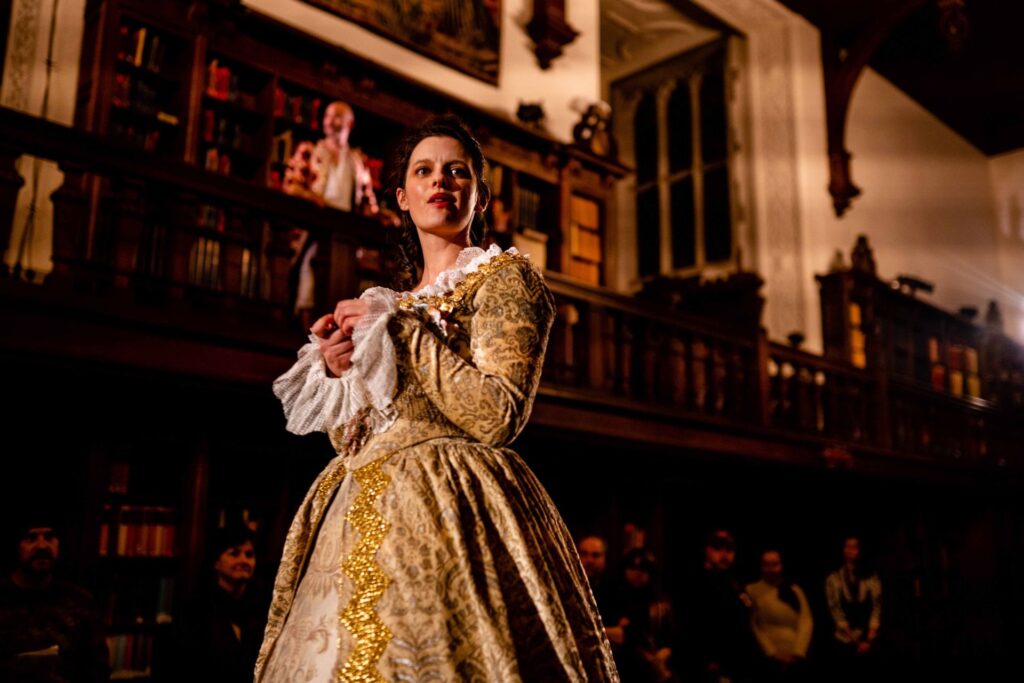
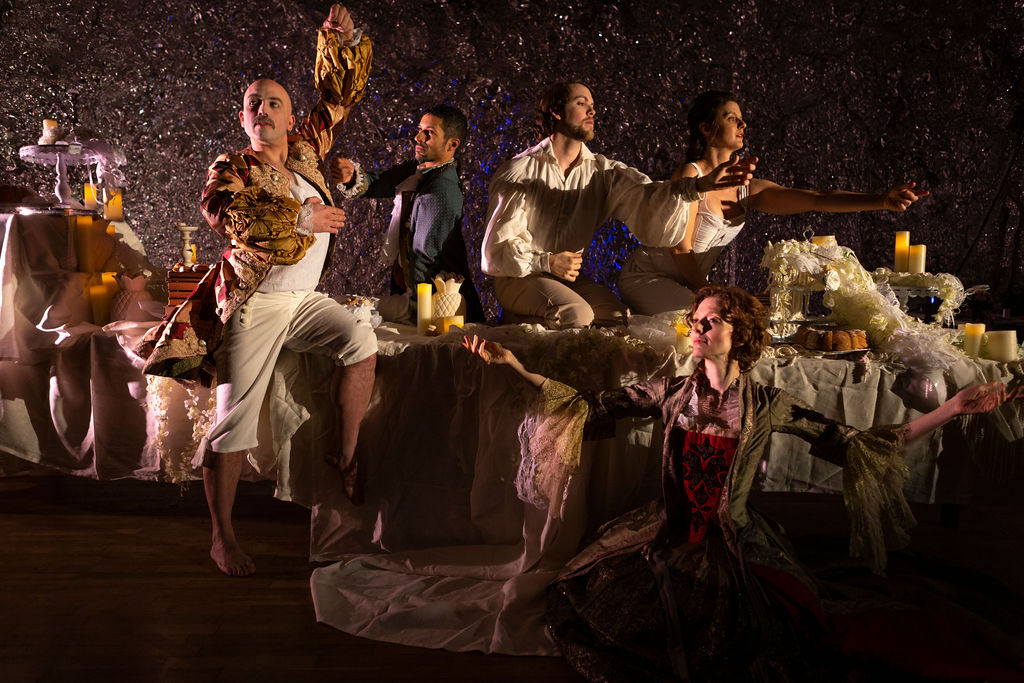
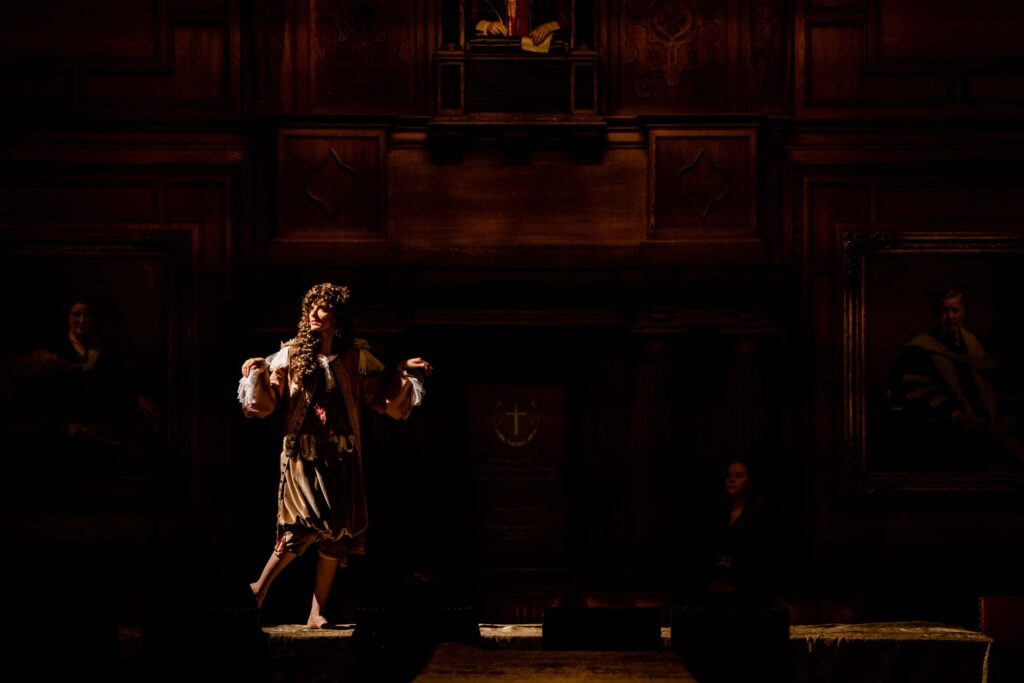
The costumes, drawn in part from Folger Theater’s costume stock, were “historically flavored but a bit over the top…evocative of the Restoration, but still a loose interpretation.” Each performer’s base costume evoked the look of loose shirts and breeches, with garments that offered a vague nod to the idea of ‘corsets’ for the company’s female members. Historical costumes, such as gowns, pumpkin pants, and ruffs, were layered over “undergarments” for costume changes.
The Confection company worked from a rich diet of the ‘Before Farm to Table’ research:
“We discovered breathtaking, jaw-dropping, and sometimes chilling accounts of the practicality and politics of food during the Early Modern era. Confection is a research-fueled romp that aims to…make manifest the corporeal cost of decadence and disparity.”
That’s a very ambitious thesis for an immersive art performance. The show’s thesis, repeated in press releases and the handouts at the performance, asks: “How much does sweetness cost, and what are we willing to devour to satisfy our appetites?”
Indulgence, Engineered: Anatomy of the Performance
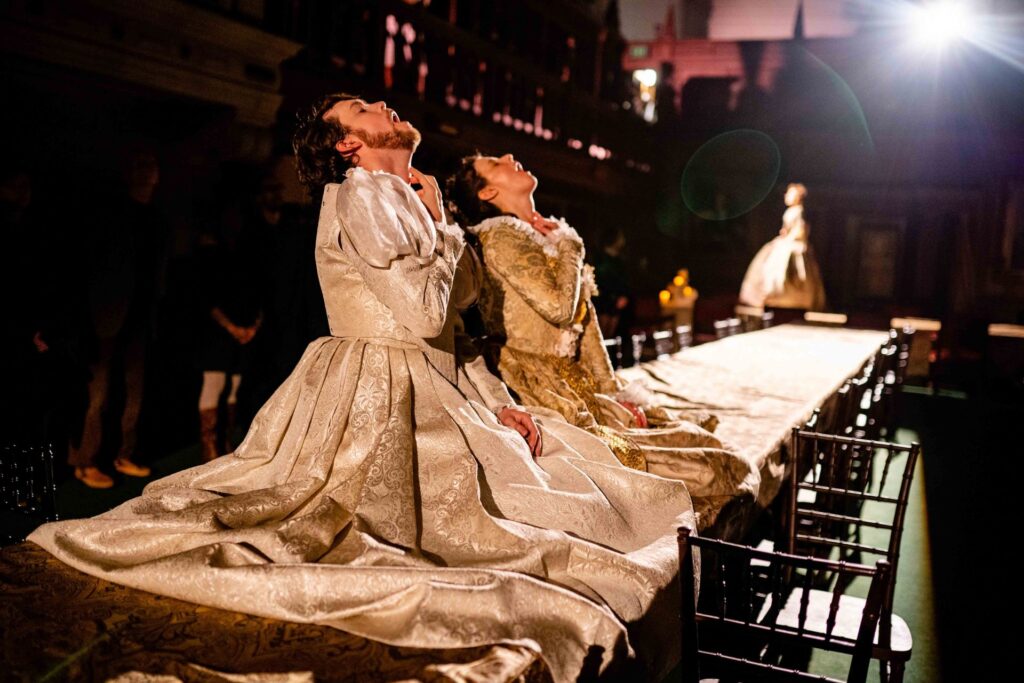
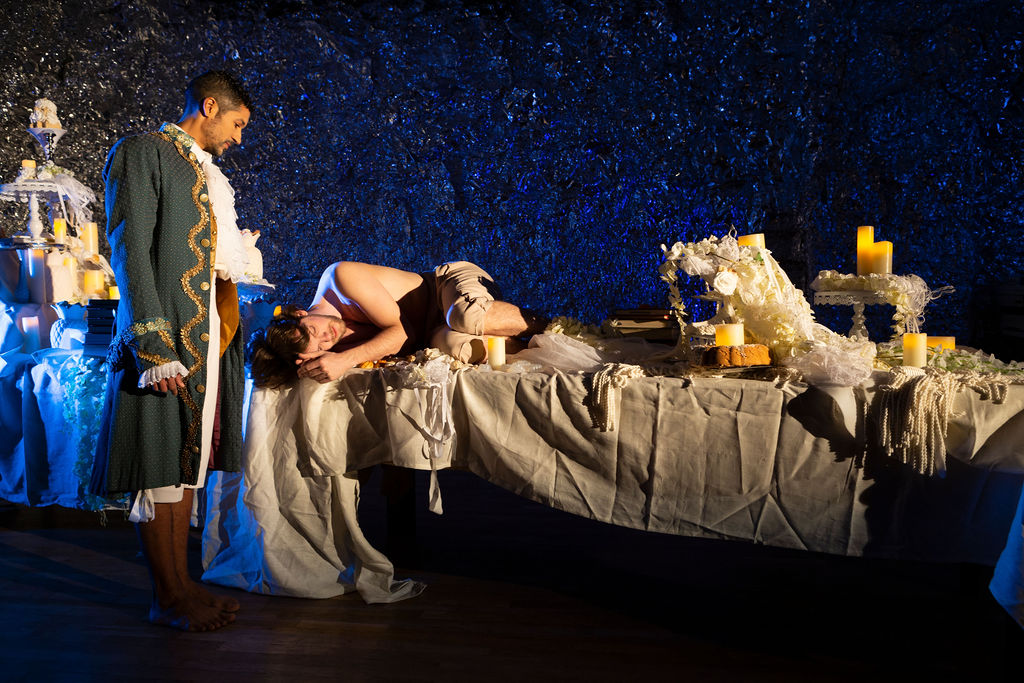
Confection was a 45-minute immersive experience held in the Folger Library’s Paster Reading Room. The grand, Tudor-inspired space has a central reading table that was transformed into a banquet table, runway, and stage.
Aptly, for a communal colloquy about consumption, the performance opened and closed with the audience of 50 seated around the table. During these beginning and ending segments, members of the company performed in spaces around the reading room (or library), utilizing the bookshelves, balconies, and ladders.
In between these bookends, the audience was divided into four or five smaller groups. Members of the company led each group through vignettes in different areas, including the Bond Reading Room and a card catalog room.
My cohort of around 10 and I followed our performer in an undulating single-file line, without speaking, stopping to watch performances by the artists stationed throughout the rooms.
The performances were largely silent, with original music and sound design by Sean Hagerty and Isaiah Singer.
Encounters in the Work: A Nonlinear Account
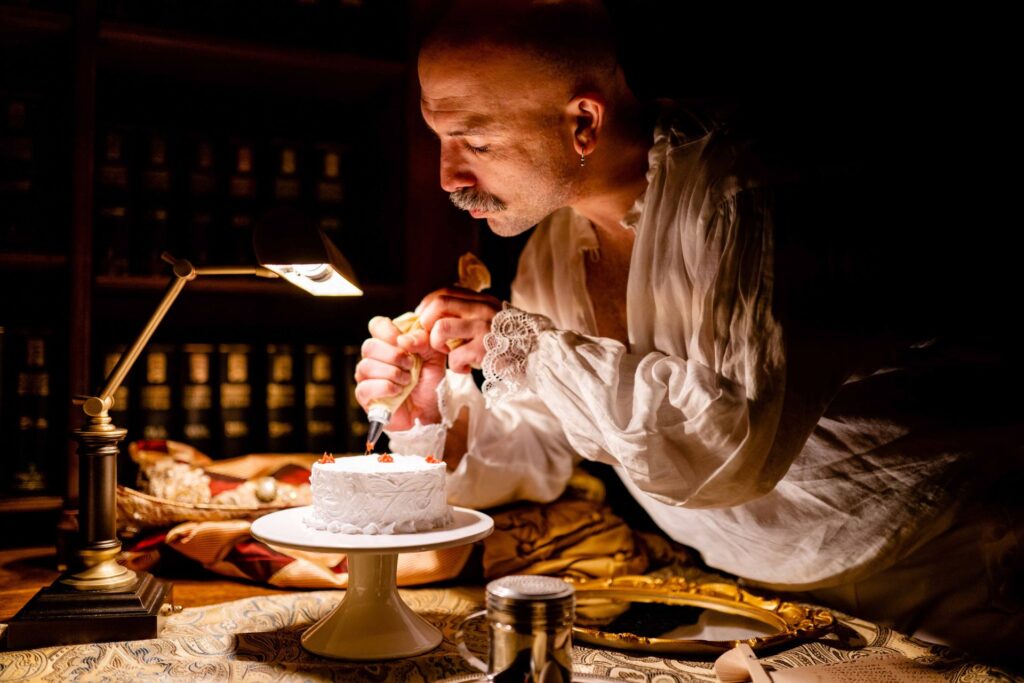
As we wound in and out of the pools of light cast by strategically placed reading lamps and other fixtures, my group approached a man decorating a cake, piping white, blue, and red from piping bags. He alternated between piping the icing onto a modest white cake or onto his paintbrush, to be goopily applied as facepaint, eyeshadow, and rouge. His sugar-based take on the era’s aristocratic makeup complete, we moved on.
In another room, a shirtless man stood with his head bowed and wrists bound, silently turned and repositioned by a fully dressed performer who spoke calmly about the “measure of a man.” The scene was charged with the hyper-aware energy of two performers who have worked extensively with an intimacy coordinator.
We wound our way through the stacks and watched an extended, detailed recitation of the proper ways to cut meat for the table.
In another scene, surrounded by in situ card catalogs, a performer repeatedly opened and closed the drawers. The sound of wood on wood punctuated the silence. The player offered a packet of hard candy, asking: “keep or share?”
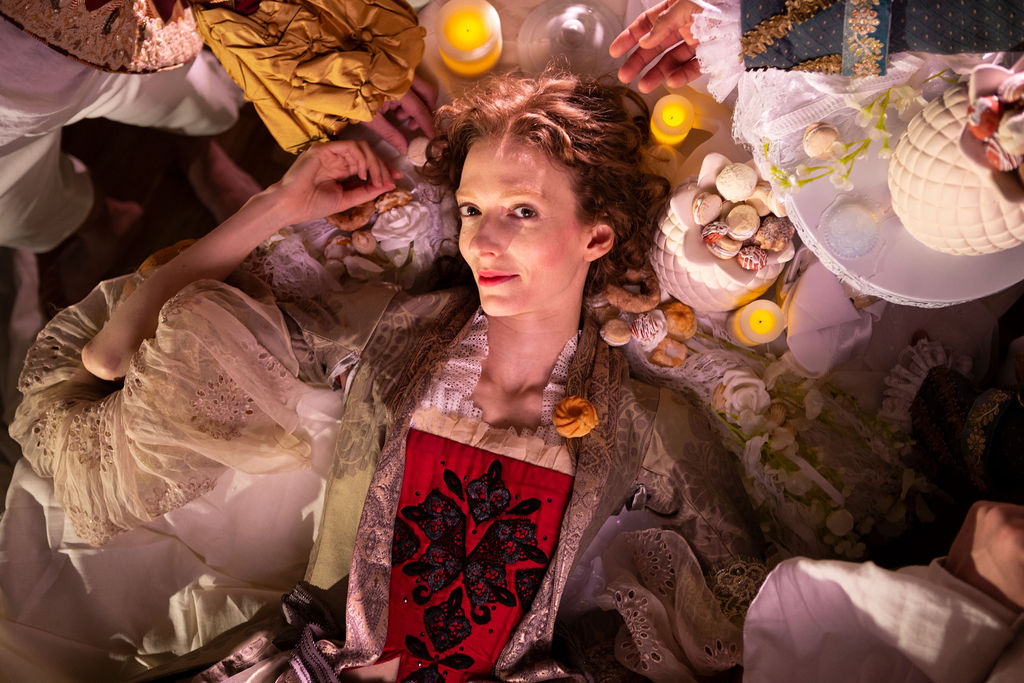
In the final scene, the audience joined the performers who were now seated at the long reading table. In a cacophanous, jubilant moment, dishes were passed down the table. Each plate varied. Some had a small but delectable dessert designed by a local pâtissier. Some had only a smear of icing or a small candy.
As we passed the plates along the table, it became clear that they were a roulette wheel. Some would have their cake, and others would be without. This was the theme of Confection, the “rollicking rumination on opulence, inequity, and teeny-tiny desserts.”
The Ethics of Indulgence: What We Take, What We Leave
Ultimately, Confection gestures toward inequity. The players strut and fret their hour upon the table, dancing with the concepts of class, wealth, and the depravity of the elite. Yet the central question—“keep or share?”—is toothless.
In practice, it offers no real dilemma. I didn’t want the sugar candy in the packet; sharing it was effortless, even preferable. But even if I had wanted it, the question’s framing already dictates the correct response. Sharing is presented as obviously virtuous, while keeping is faintly embarrassing. There is no space for ambivalence, self-interest, or contradiction—only a rehearsed moral cue that feels trite rather than revelatory.
What bite could it have?
The piece asks viewers to reflect on fairness while positioning them, inevitably, among the winners. The moral tension is cosmetic. No one is meaningfully deprived, no one is discomforted, and the structure ensures that any “choice” will resolve neatly. (And the ticketholders have paid to have a nice, perhaps thought-provoking, evening out.)
We are seated at the banquet, and it’s easy to imagine this means equality. Even when the roulette wheel offers little, the work seems to ask: Would you really refuse to share? The answer is preordained, and the audience knows it. Instead of prompting reflection, the piece congratulates participants for complying with a social script they were never likely to resist.
Because of this, Confection doesn’t quite hit the spot. Its moral arc is too obvious, its stakes too low, and its mechanisms too transparent. Rather than unsettling the audience, exposing something uncomfortable about generosity, power, or inequality, it reassures them. What’s left is not a meaningful exploration of inequity, but a polite simulation of it—sweet and easy to consume.