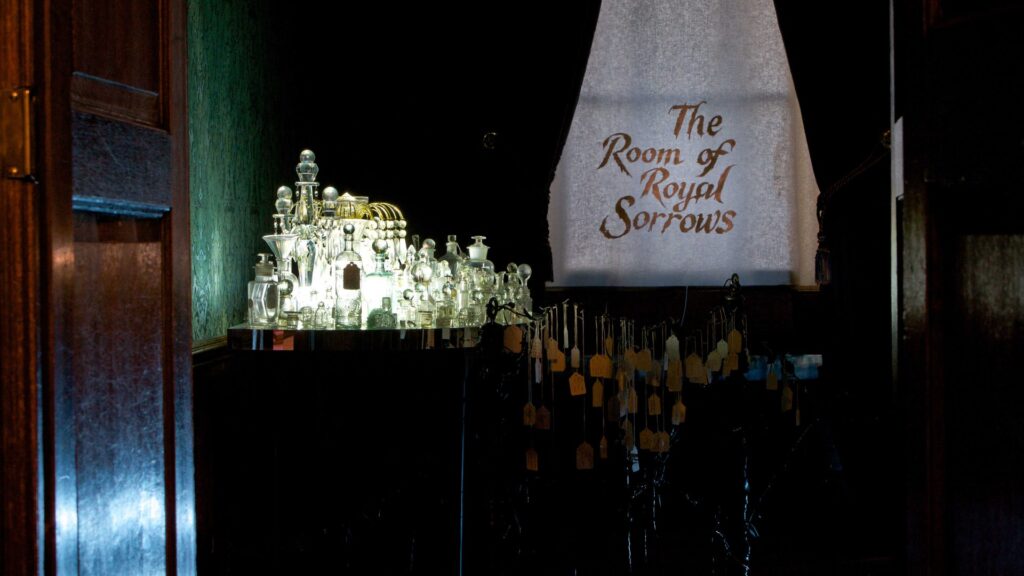
The Room of Royal Sorrows
For three years, Kensington Palace showcased an exhibit called the Enchanted Palace, which I visited in 2012 and have described in a blog post here.
I also wrote a post about the audience response to this exhibit.
One of the spaces most enduring in my memory is the Room of Royal Sorrows. In this exhibit, Mary II’s historic bedchamber became a space of manifested grief.
Inspired by historical accounts of 15-year-old Mary weeping for days after being informed of her impending diplomatic marriage, Wildworks designer Bill Mitchell layered the room with references to the romantic (and mythical) idea of lachrymatories, or tear catchers. Small glass bottles appeared to fill the mirrored space, multiplying endlessly in reflection.
Fluttering tags, each enumerating a sorrow, introduced movement and quiet accumulation. Nearby, Princess Diana’s extant gown by Bruce Oldfield seemed to regard her own reflection, folding contemporary memory into the room’s historical grief.
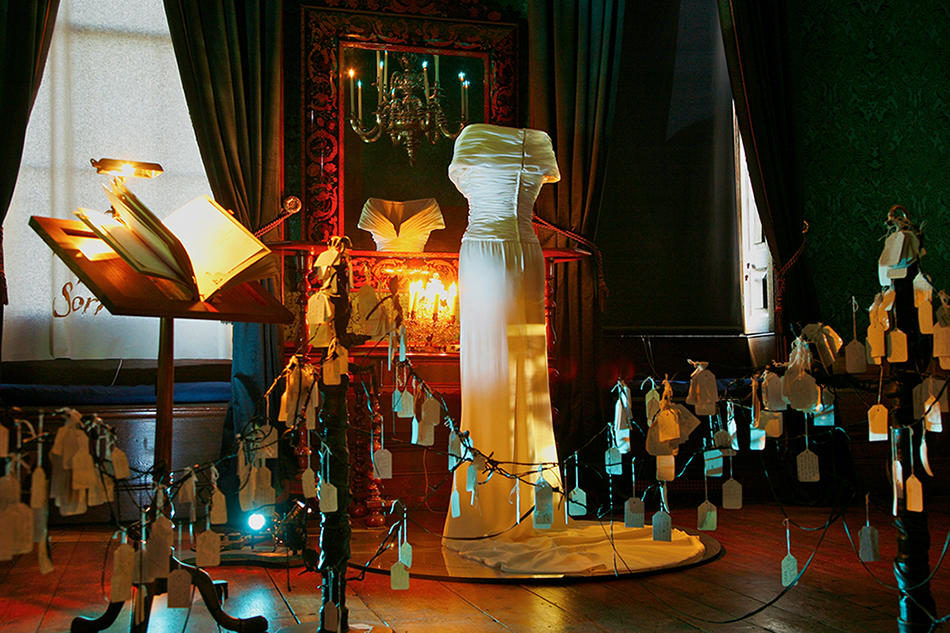
The Dress of Tears
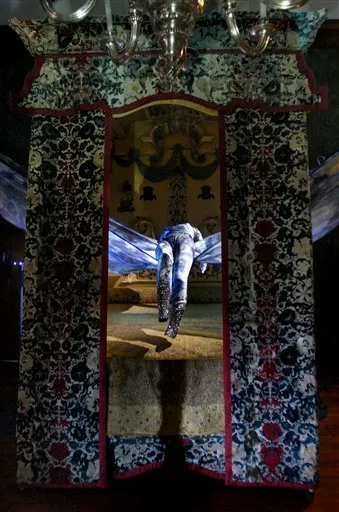
The glittering Dress of Tears, designed by Maki Aminaka and Marcus Wilmont, floated above the historic bed. A hollow mannequin wearing a gemstone-encrusted bodysuit caught the light. The silk flanking the figure was printed with motifs of rain streaking down windows, drifting smoke, and “vague and indistinct babies in the womb.”
Cradled as it was above the bed, the figure became a potent symbol of the marriage bed, childbirth, miscarriage, and death, generations of royal sorrow collapsing into a single suspended form.
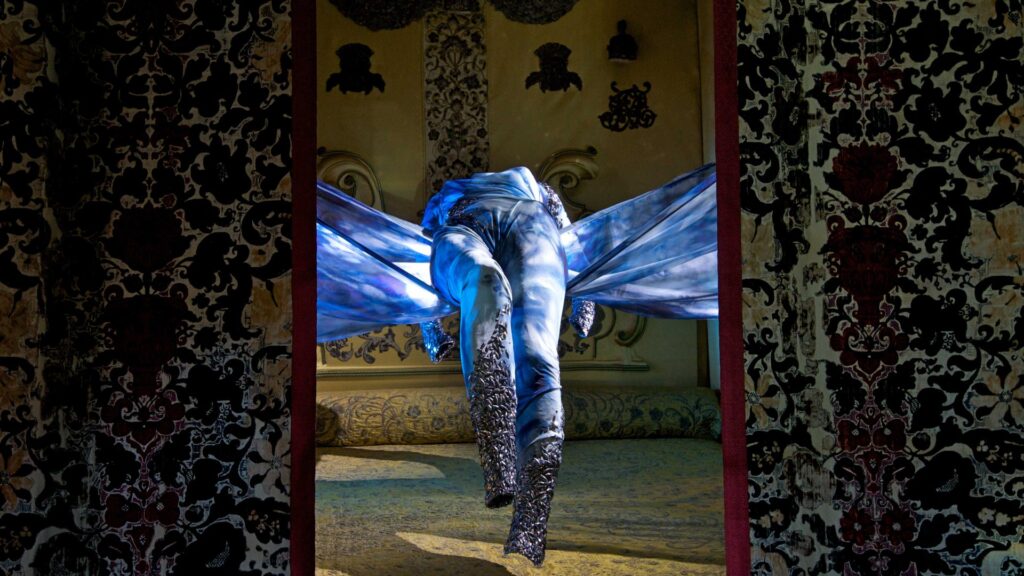
The imagery of the dress and its placement above the bed draws on references to Mary’s life. She wept at the news of her arranged marriage to an ugly cousin 12 years her senior, through the wedding ceremony, and continued to cry as her uncle, the King, drew the bedcurtains around the couple during the bedding ceremony. Later in the marriage, she experienced at least two miscarriages. At the age of 32, smallpox confined her once again to bed, this time as her deathbed.
When Historical Fidelity Fractures
Behind-the-scenes interviews reveal that the contributing artists’ levels of historical knowledge, and their fidelity to it, varied widely. Although the Dress of Tears was assigned to represent Mary, specifically, in the associated interview, the artists reference the many miscarriages of Mary’s sister, Anne. (Anne, meanwhile, appears elsewhere in the exhibition in The Room of Quarrels, where an argument with a beloved childhood friend escalates beyond repair.)
Mary and her sister Anne both dealt with childlessness. After Mary’s early death, her husband ruled alone until his death. Anne succeeded him with her husband. Despite at least 17 pregnancies in as many years, Anne died without surviving issue.
In The Enchanted Palace, Mary’s grief cannot be cleanly separated from Anne’s, or from the broader, shared experience of royal women whose lives were shaped by expectation, confinement, and loss. In this way, the Dress of Tears becomes an amalgam of many women, not a portrait of a single woman.
Emotional Truth Over Historical Precision
There’s also the matter of the “tear catchers”. Despite their basis in romantic myth, the designers earnestly share them as historical fact. Like the misattributed miscarriages, they gesture toward emotional truth rather than factual precision.
In this exhibit, the Enchanted Palace reveals its greatest strength: not historical accuracy, but emotional truth drawn from overlapping lives.